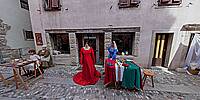

Stretta della Giudaica (durante "il Palio")
Stretta della Giudaica, Cividale del Friuli (Ud), Italy
August, 24th, 14,46 local time (UTC+2)

© 2025 Roberto Mancuso, All Rights Reserved.
Stretta della Giudaica is today a very narrow lane in the historic center of Cividale del Friuli that preserves in its name the memory of the medieval Jewish presence in the town, even though its current appearance is that of an ordinary historic alley with houses, small workshops, and remains of ancient walls. More than a closed “ghetto”, it evokes an area where the Jewish community gravitated between the thirteenth and sixteenth centuries, in an urban context in which Jews were relatively integrated into the economic and social life of the town.
Name origin and urban setting
The toponym “Stretta della Giudaica” derives from the Jewish settlement which, from the late Middle Ages, was mainly concentrated in the eastern part of Cividale, close to the ancient walls and city gates. The area is a narrow passageway, with tightly packed houses and traces of the first Roman city wall, which show how the medieval town was built on and within the structures of the ancient municipium.
The Jewish community in Cividale
The Jewish presence in Cividale is documented at least from the thirteenth century: in 1239 a rabbinic source (the Or Zarua) mentions a rabbinical court active in the town, proof of an already structured community. Fourteenth‑century documents (such as the 1349 agreement between the municipality and the Jewish community) recognize the Jews’ right to live and work in the town, engaging not only in moneylending but also in trade and medicine, which was by no means taken for granted compared to other European centers.
Daily life “in the Giudaica”
The Jews were not confined in a walled ghetto: they lived in various parts of the town, but the area known as the Giudaica, around today’s Stretta, was one of the main hubs, close to traffic routes and market spaces. Daily life alternated religious moments (festivals, Sabbath rules, food laws) with full participation in the town’s dynamics: lending activities, shops, relationships with Christian artisans and peasants, regulated also by statutes that required mutual respect for the festivals of both communities.
Decline, expulsion, and material memory
From the fifteenth century onward, the situation worsened: under political and religious pressure, Venice – which controlled the area – decided to expel the Jews from Cividale, a measure formalized in 1572; after this date, no stable community was re‑established in the town. Of the former Jewish cemetery, connected to the memory of the Giudaica, a few fifteenth‑century and later gravestones remain, now preserved in the National Archaeological Museum, while a Hebrew inscription is walled into the arch of Porta Arsenale, concrete signs of a presence later removed but still legible in stone and in the place‑names.
The Stretta today
Today Stretta della Giudaica is an evocative passage between old houses, close to historic workshops such as the “Farie Geretti”, the last surviving witness of the blacksmith tradition in the lane, and is often included in Jewish and Lombard cultural itineraries of the town. Walking through it means crossing in just a few meters different layers of history: from Roman walls to Lombard layouts, up to the memory of the medieval Jewish community that contributed to the economic and cultural life of Cividale, later expelled and almost erased from the real town, but not from the town of memory.
-In the pano you can see a particular event called: Palio di San Donato:
The Palio di San Donato (often simply called “the Palio”) is a historical reenactment held every year in August in Cividale del Friuli, in honor of Saint Donatus, the city’s patron saint, around the liturgical date of 21 August. The festival combines solemn religious celebrations in the Cathedral with a large medieval-style city tournament between the historic districts, turning the center for three days into a true fourteenth‑century setting with costumes, parades, and performances.
Historical origins
- The roots of the Palio go back at least to the Middle Ages: local studies trace it to around 1128, and the first documented mention is from 1361, when expenses for “lu palit” of Saint Donatus are recorded.
- In the Patriarchal era the Palio celebrated the prestige of Cividale, then capital of the Patriarchate of Aquileia, and in 1368 the city council decreed that it should be held “in perpetuity.”
The competitions and districts
- Today the main competitions are the running race and the archery and crossbow contests between the five walled districts: Duomo, San Pietro, San Domenico, Brossana, and Ponte.
- Originally there were also horse races (“palit da chaval”) and other martial events, in which champions from the city districts and from nearby castles and towns took part.
Festival atmosphere
- During the days of the Palio, the historic center fills with taverns, markets, musicians, drummers, jesters, fire-eaters, and reconstructions of medieval settings, with hundreds of participants in historical costume.
- The religious dimension remains central: alongside the competitions there is a solemn mass in the Cathedral with the display of the reliquary bust of Saint Donatus and the blessing of the city, followed by the solemn procession with the Palio banner.
here you can see a particular set up for the Palio's days
Lat: 46° 5' 40.208" N
Long: 13° 25' 55.146" E
Precision is: High. Pinpoints the exact spot.
Canon 5D II, Canon fish-eye 15/2,8, Manfrotto tripod 058, Agno's panohead, PtGui, Psno2vr, Phohotshop
 Tap or click the zoom icon in the bottom right corner of the picture to switch between in-page and fullscreen view